
Building Systems Commissioning — Interior BC
We Do Commissioning Better.
Independent, field-based commissioning for healthcare facilities, LEED projects, institutional buildings, and complex commercial developments — serving BC and Western Canada from offices in Kamloops and Kelowna since 1986.
10+
Recent full hospital tower commissioning projects completed
100%
Pre-functional checklists and FPTs completed in-house
2
BC offices — Kamloops & Kelowna
What Is Commissioning
Commissioning That Verifies Real Building Performance Before Handover.
Technical Definition
Building commissioning is the process of verifying that a facility’s mechanical, electrical, plumbing, controls, and integrated systems are designed, installed, tested, and capable of operating in accordance with the Owner’s Project Requirements.
At handover, contractors confirm their systems are complete. Commissioning goes further: it’s independent verification that those systems are actually operating as intended, before the owner accepts responsibility for them.
Without commissioning, owners can inherit systems with installation deficiencies, untested control sequences, incomplete integration, and equipment that looks compliant on paper but underperforms in operation. Catch these during construction and they’re usually faster, easier, and cheaper to fix.
For healthcare facilities, LEED projects, and complex institutional buildings, commissioning is often required by project specifications, owner standards, building code pathways, CSA standards, and certification programs. ITSL provides the independent oversight needed to meet those requirements and protect the owner’s long-term operational interests.
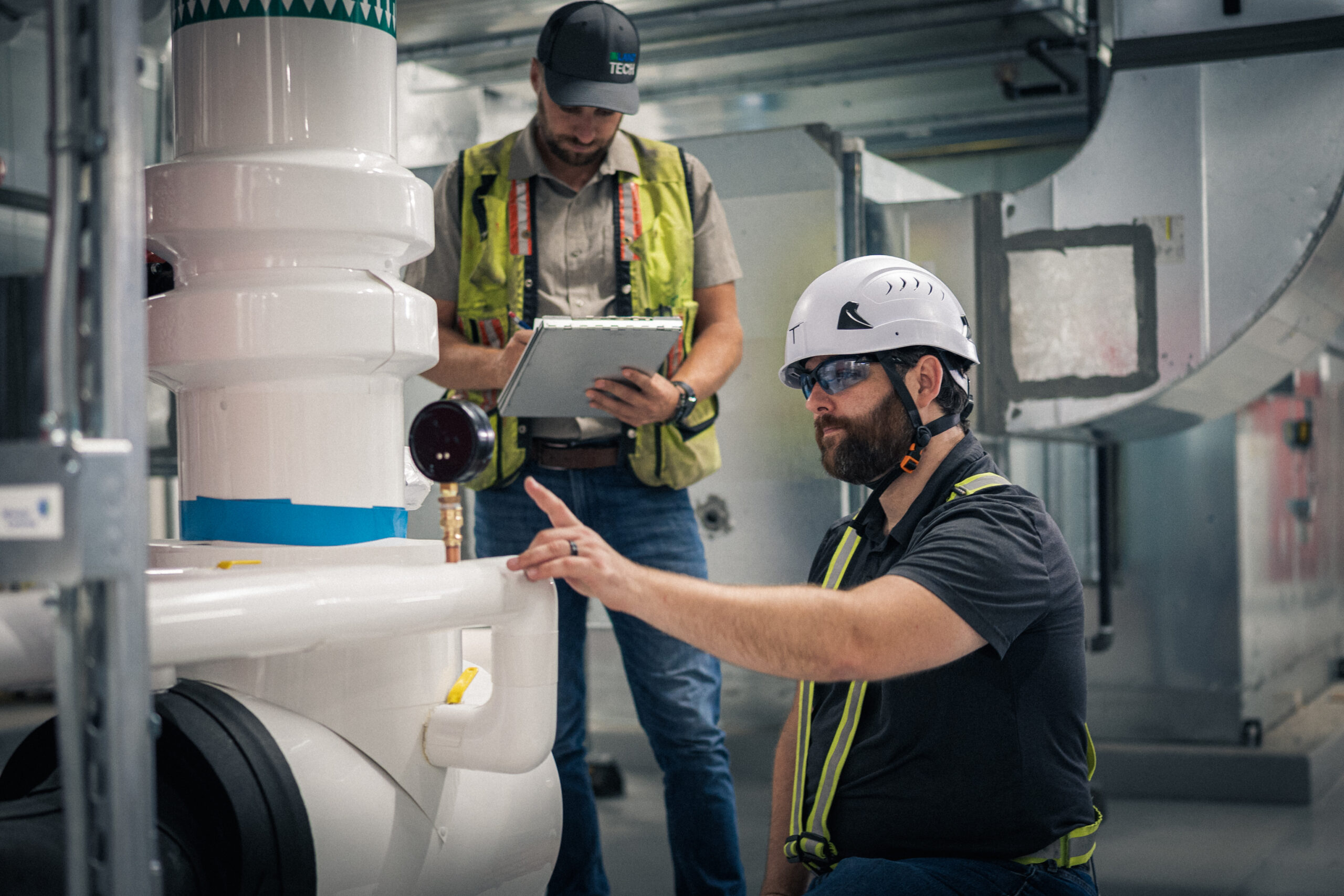
ITSL’s approach goes beyond a checklist. Our providers are in the field, observing systems under real operating conditions, testing control sequences, reviewing design documentation, and tracking issues. We work directly with owners, consultants, and contractors to resolve problems before turnover.
We keep contractor quality control and independent commissioning verification separate. Contractors stay responsible for their own installation checks, startup, and deficiency correction; our role is the objective review on behalf of the owner and project team — verifying required prefunctional checks, completing functional testing, reviewing system sequences, documenting deficiencies clearly, and confirming issues actually get resolved. We bring TAB, controls, mechanical, electrical, IMIT, and integrated systems testing experience into every commissioning engagement, so we’re looking at how the building actually operates: airflow, hydronic flow, pressure relationships, control response, equipment operation, and life safety integrations, all reviewed together for a clearer picture of real building performance.
Every project is scoped to match its complexity. We support owners, consultants, contractors, and facility teams with hands-on field verification, practical coordination, clear issue tracking, and reliable closeout documentation.
Our Process
Commissioning From Design Through Handover
Effective commissioning starts before construction and continues until systems are tested, documented, and ready for operation. ITSL provides continuity through each phase, connecting design review, field verification, functional testing, issue tracking, and owner training into one coordinated process.
01
Design Review and Commissioning Planning
ITSL reviews the Owner’s Project Requirements, Basis of Design, drawings, specifications, and commissioning scope to identify gaps early. This helps the project team address unclear requirements, coordination issues, access concerns, and testing expectations before they become field problems.
02
Construction Observation and Prefunctional Checks
During construction, ITSL performs prefunctional checks in the field to verify that equipment is installed, started, communicating, and ready for testing. Many commissioning providers rely on installing contractors to complete these checks on their behalf — that can create gaps, where issues get missed and deficiencies don’t turn up until functional testing begins. ITSL’s approach gives the owner a more reliable view of equipment readiness before sequence verification starts.
03
Functional Performance Testing and Issue Tracking
Functional Performance Testing happens in two stages: first equipment operation is verified, then ITSL tests control sequences, operating modes, safeties, alarms, interlocks, and system integration. Job progress, test status, and open issues are tracked through cloud-based software so the project team can review progress in real time.
04
Reporting, Manual, Training and Handover
ITSL delivers the final commissioning report, issues log, commissioning documentation, and Cx Manual, and supports owner and operator training so the facilities team understands how systems are meant to operate, be maintained, and be verified after turnover. Handover comes out cleaner, with fewer unresolved issues and better building performance over the long term.
Real-Time Tracking via Bluerithm: Every deficiency, checklist, and test result is tracked in Bluerithm’s cloud-based commissioning platform. Owners, consultants, and contractors get live access to project status, the issues log, and test records throughout the commissioning process — no waiting for monthly reports to find out where a project stands.
Recommissioning Process
Existing Building Commissioning That Starts in the Field
Recommissioning improves how existing buildings operate without jumping straight to major capital upgrades. ITSL’s process starts by understanding the owner’s current requirements, reviewing available documentation, and verifying how the building is actually performing in the field.
01
Planning and Building Review
ITSL reviews available drawings, O&M information, BAS graphics, past reports, energy data, and owner concerns to understand the building, its history, and known operating issues.
02
TAB Survey and Field Investigation
ITSL recommends a TAB survey at the beginning of every recommissioning project — a functional test of the distribution systems that confirms how air and water are actually moving through the building before recommendations are made, separating balancing issues from control issues, equipment issues, or design limitations.
03
Controls and Sequence Review
ITSL reviews BAS operation, schedules, setpoints, alarms, trend logs, and control sequences to confirm whether systems are operating as intended — using field testing to verify actual operation, not just what appears on the BAS screen.
04
Issues Log and Recommendations
Findings are documented in an issues log with practical recommendations for correction — focused on low-cost and no-cost improvements first, including balancing corrections, control adjustments, scheduling changes, sensor issues, and operational improvements.
05
Implementation and Verification
Once corrective actions are approved, ITSL supports implementation review, retesting, and verification — confirming that the recommended changes were completed and that the building is operating closer to the owner’s current requirements.
06
Ongoing Commissioning Support
ITSL also supports ongoing commissioning through periodic reviews, trend log analysis, functional retesting, and updated documentation to help maintain building performance over time.
Commissioning Services
What ITSL Delivers on a Commissioning Engagement
Our commissioning scope adapts to each project type, from new hospital towers to existing facility retrofits.
New Building Commissioning
Full commissioning scope for new construction: design review through functional testing and handover documentation. Aligned with CSA Z320, ASHRAE Guideline 0, and LEED requirements. ITSL serves as the independent Commissioning Authority, with no conflicts with the installing contractors.
Healthcare Commissioning
Specialist commissioning for BC acute care hospitals, long-term care facilities, and medical office buildings. ITSL has delivered commissioning services across many major healthcare projects, including full hospital towers, clinical care buildings, and phased renovations in active care environments. Our team understands the coordination, documentation, infection control, procurement, and compliance expectations required for BC Health Authority projects.
LEED Commissioning
Commissioning Authority services for LEED Fundamental and Enhanced Commissioning requirements. ITSL manages the Owner’s Project Requirements, reviews contractor submittals, and delivers the commissioning report required for LEED certification submission, for both the CaGBC and international pathways.
Existing Building Commissioning
The Biggest Energy Losses Aren’t at the Equipment — They’re in the Distribution System
Retrocommissioning and recommissioning both improve the performance of existing buildings. Retrocommissioning applies when a building has never gone through a formal commissioning process; recommissioning applies the process again to a building that was previously commissioned but no longer operates as intended due to age, renovations, occupancy changes, control adjustments, or operational drift.
Our existing building commissioning process starts with understanding how the building is actually moving air and water. In many buildings, the biggest operational and energy problems aren’t found at the equipment nameplate — they’re found in the distribution systems, in airside and hydronic systems that are leaking, out of balance, improperly controlled, or no longer delivering flow where it’s needed. Lawrence Berkeley National Laboratory has shown that distribution system losses can be significant, including substantial fan energy increases from duct leakage and meaningful capacity losses from duct conduction. That’s why we put this much emphasis on field survey and verification of these systems.
Our work focuses on site investigation, distribution system survey, controls review, TAB assessment, and functional testing of existing systems. The goal: find where energy is being wasted and where building performance has drifted from intended operation. As a BC Hydro Continuous Optimization Program approved service provider, we bring that same performance-focused approach to existing buildings — giving owners a practical read on current conditions and a clear basis for low-cost corrective measures before anyone considers major capital upgrades.
Existing building commissioning is widely recognized as a strong energy performance measure. Berkeley Lab reports typical savings in the range of 10% to 30%, with median whole-building savings around 16%.
Ongoing and Monitoring-Based Commissioning
Commissioning shouldn’t end at turnover. Buildings change over time — spaces get renovated, schedules shift, controls get adjusted, equipment ages, and operating priorities change. Ongoing commissioning helps owners maintain system performance after occupancy by periodically reviewing operation, catching drift, and confirming systems still meet current building needs.
Monitoring-based commissioning uses BAS trend data, utility data, alarms, schedules, setpoints, and equipment operation to flag performance issues that might not be obvious during daily operation — including simultaneous heating and cooling, excessive runtime, failed sensors, control sequence issues, unstable temperatures, ventilation concerns, and energy waste. ITSL supports ongoing and monitoring-based commissioning through practical field review, trend analysis, functional retesting, TAB surveys, issue tracking, and operator support, helping facility teams maintain comfort, ventilation, energy performance, and reliable system operation over the life of the building.
78%
of existing buildings with reported deficiencies have thermal distribution issues.
Yet this is hardly discussed in practice.
Thermal distribution
78%
HVAC
60%
Cooling plant
55%
Heating plant
47%
Terminal units
33%
Lighting
26%
EMS
20%
Deficiency rates by category, existing buildings. Source: Mills, E. (LBNL), “Principles of Building Commissioning,” presented through ASHRAE.
Drone Thermal Imaging
Seeing What Ground-Level Inspection Misses
Inland Technical Services provides drone-based thermal imaging to support building envelope reviews, HVAC system assessments, maintenance planning, and existing building performance investigations — identifying temperature patterns that are difficult to see from the ground or through visual inspection alone.
Building Envelope Reviews
For building envelopes, drone thermal imaging can help spot potential heat loss, insulation gaps, thermal bridging, air leakage, moisture-related concerns, roof anomalies, and areas where the building envelope may not be performing as intended — supporting facility planning, energy reviews, renovation planning, and further investigation by the owner or consultant team.
Mechanical Equipment Reviews
For mechanical equipment, thermal imaging can help review roof-mounted equipment, ducts, piping, coils, valves, heat exchangers, pumps, fans, and other HVAC components where abnormal temperature patterns may indicate performance issues — flagging potential heat loss, failed insulation, control issues, leaking valves, poor heat transfer, or equipment that may need further testing or maintenance.
Drone thermal imaging is especially useful for large buildings, rooftops, difficult-access areas, and existing facilities where safe and efficient site review matters. Combined with TAB experience, commissioning review, controls verification, and field measurements, it adds another layer of information to help understand how a building is actually operating. Results are documented with clear photos, location references, observations, and recommendations for follow-up review — practical information owners, consultants, and facility teams can use to catch issues earlier and prioritize corrective work.
Energy Optimization
Energy Efficiency Starts With Systems That Are Actually Operating Correctly
Inland Technical Services helps owners identify energy waste by reviewing actual HVAC system performance in the field — not just from utility data or control trends. Our team combines testing, adjusting and balancing, commissioning review, controls verification, and measured field data to understand how air and hydronic systems are performing, catching issues like excessive airflow, incorrect outside air quantities, simultaneous heating and cooling, poor scheduling, failed dampers, leaking valves, inefficient fan or pump operation, and systems that no longer match the building’s actual needs.
Energy optimization reviews can include:
- Fan and pump performance review
- Airflow and hydronic flow assessment
- Outside air and exhaust verification
- Control sequence review
- Setpoint and scheduling review
- Energy loss identification
- Thermal imaging
- Mechanical system performance review
- Recommendations for practical efficiency improvements
Our focus is on practical, achievable improvements that support comfort, reliability, maintainability, and reduced energy use. By understanding how the building is actually operating, Inland Technical helps owners prioritize corrective work, reduce unnecessary energy consumption, and improve long-term mechanical performance.
Renovation & Phased Cx
Commissioning of phased renovations and tenant improvements in occupied facilities, including hospitals, university buildings, and civic facilities. ITSL manages the sequencing complexity of commissioning active buildings where systems must remain operational throughout construction.
Commissioning Management
For owners and project managers who need commissioning coordination across multiple disciplines, ITSL provides commissioning management services that integrate mechanical, electrical, controls, and life safety testing into a single, coordinated program. Includes stakeholder reporting and milestone management.
Healthcare Specialization
BC’s Most Experienced Independent Commissioning Firm for Hospital Projects.
Healthcare facilities are the most demanding commissioning environments in the built environment. Infection control zones, life safety systems, medical gas distribution, isolation rooms, and 24/7 operational requirements create a commissioning complexity that general firms are not equipped to manage.
New Hospital Developments
ITSL has extensive experience supporting new hospital developments throughout BC and Western Canada, including Royal Inland Hospital Patient Care Tower (LEED Gold, 2023), Kelowna General Hospital, Penticton Regional Hospital, and Comox Valley Hospital. Our team has worked on major healthcare projects involving mechanical commissioning, testing, adjusting and balancing, integrated systems testing, controls verification, and closeout documentation.
On new hospital projects, system performance cannot be assumed from design documents or contractor sign-off alone. ITSL works directly in the field with the owner, consultants, contractors, and facility teams to verify that building systems operate as intended — confirming performance at the equipment, documenting deficiencies clearly, and supporting resolution before the building is turned over to operations. Our team recently completed Integrated Systems Testing (CAN/ULC S1001) for both Penticton Regional and Royal Inland Hospital — the most complex life safety commissioning scope available.
Operating Healthcare Facilities
Existing hospitals require regular review to confirm that critical systems continue to operate safely, reliably, and efficiently. ITSL supports operating healthcare facilities with field-based testing, balancing reviews, recommissioning, and performance verification for mechanical, controls, and critical environment systems — evaluating isolation rooms, procedure rooms, operating rooms, pressure-controlled spaces, exhaust systems, ventilation systems, and other critical environment areas where airflow, pressure relationships, temperature control, energy use, and system response all matter for patient and staff safety.
In existing buildings, energy efficiency is often affected by control sequences, unoccupied operation, incorrect airflow, sensor issues, simultaneous heating and cooling, failed valves or dampers, and systems that have drifted from their original intent. ITSL combines TAB experience, commissioning review, controls verification, and field measurements to find where systems are wasting energy — while confirming that healthcare performance requirements stay met, so facility teams can catch issues before they become larger operational problems.
Healthcare Commissioning Standards
10+
Full hospital tower commissions across BC
2
Recent IST completions — Penticton Regional & Royal Inland
LEED Gold
Royal Inland Hospital Patient Care Tower, 2023
Interior BC
The only specialist commissioning firm based in the BC Interior
LEED Commissioning — Across BC and Beyond
The Commissioning Authority for BC’s Most Demanding Sustainable Building Projects.
LEED certification requires an independent Commissioning Authority: a qualified third party not affiliated with the project’s design or construction team. For LEED projects in Interior BC, ITSL is the most experienced, most credentialled option available.
Our team has served as Commissioning Authority on LEED Gold buildings including Royal Inland Hospital Patient Care Tower (2023), UBCO Health Sciences Building (2011), Penticton Regional Hospital Patient Care Tower, Comox Valley and Campbell River Hospitals, and multiple BC Housing and Okanagan College projects.
LEED commissioning is not just a checkbox. The buildings we commission perform better over their lifetimes because the commissioning process forces design teams and contractors to verify that systems function as designed, not just installed. The energy and operational savings from well-executed commissioning typically far exceed the cost of the commissioning scope itself.
We align our LEED commissioning work with ASHRAE Guidelines 0 and 1.1, CaGBC LEED v4 requirements, and BCxA best practices — ensuring that the commissioning process delivers both certification compliance and genuine building performance.
LEED Fundamental Commissioning
Minimum requirement for most LEED certifications. Covers mechanical, electrical, and controls systems. Required for LEED BD&C and ID&C projects.
LEED Enhanced Commissioning
Additional credit requiring expanded scope: envelope commissioning option, systems manual, operator training, and post-occupancy review. Highest value for long-term building performance.
LEED O+M Recertification
Existing buildings pursuing LEED Operations & Maintenance certification or recertification. ITSL’s retro-commissioning scope can support LEED O+M energy and water performance credits.
Envelope Commissioning
Optional LEED Enhanced credit. ITSL partners with other specialized firms to verify building envelope system performance — air barriers, fenestration, and thermal continuity — as an extension of the mechanical commissioning scope.
Recent Commissioning Projects
Proof of Work Across Interior BC and Beyond
A selection of commissioning projects completed by ITSL’s team — spanning healthcare, education, civic, and residential sectors.
Healthcare · LEED Gold
Royal Inland Hospital — Patient Care Tower
Full commissioning and Integrated Systems Testing (CAN/ULC S1001) for the new Patient Care Tower at Royal Inland Hospital in Kamloops. One of the most complex healthcare commissioning scopes completed in the BC Interior. LEED Gold certified, 2023.
Healthcare · LEED
Penticton Regional Hospital — Patient Care Tower
Commissioning and Integrated Systems Testing for the Penticton Regional Hospital Patient Care Tower. Full mechanical and life safety commissioning scope delivered under CSA Z8001 and CAN/ULC S1001 requirements for BC Health Authority.
Healthcare · Kelowna
Kelowna General Hospital — Multiple Phases
Ongoing commissioning relationship across multiple renovation and expansion phases at Kelowna General Hospital — including cardiac, operating room, MRI, and catheterization lab projects. Extensive experience with occupied hospital commissioning in the Okanagan.
Education · LEED Gold
UBCO Health Sciences Building
Commissioning Authority for UBC Okanagan’s Health Sciences building — one of the first LEED Gold academic facilities in the BC Interior. Complex laboratory HVAC commissioning including fume hood exhaust systems, pressurization, and BAS integration.
Healthcare · Coastal BC
Comox Valley & Campbell River Hospitals
Full commissioning scope for the new Comox Valley Hospital and Campbell River Hospital — LEED certified facilities on Vancouver Island demonstrating ITSL’s province-wide commissioning capability beyond the BC Interior.
Civic & Education
Thompson Rivers University — Multiple Buildings
Commissioning and retro-commissioning across multiple TRU campus buildings in Kamloops, including the Library and Old Main Retrofit. ITSL’s Kamloops office has a long-standing relationship with TRU facilities management and construction teams.
Why Inland Technical
What Sets ITSL Apart as a Commissioning Firm
Healthcare Commissioning Experience
ITSL has extensive commissioning experience across BC acute care hospitals, long-term care facilities, medical office buildings, clinical care facilities, and phased renovations in active healthcare environments. Our team understands the coordination, documentation, infection control, procurement, and compliance expectations required for BC Health Authority projects.
Full Field Verification
ITSL’s commissioning process is field-based. Our CxPs perform prefunctional checks, equipment operational checks, and functional performance testing directly, rather than relying only on contractor-completed paperwork or representative sampling. This gives owners a clearer, more reliable record of equipment readiness, system operation, deficiencies, and final resolution.
Commissioning Providers With TAB Field Experience
Many of ITSL’s commissioning providers have a strong background in testing and balancing — giving our team practical field knowledge of airflow, water flow, pressure relationships, equipment performance, and distribution system issues. That TAB experience also means our providers arrive with direct know-how in commissioning scheduling, spotting roadblocks, and understanding how systems need to be started, balanced, and staged for commissioning milestones — helping identify issues that may not be obvious from drawings, BAS graphics, or written sequences alone.
Built-In Mechanical, Electrical, Controls and Systems Knowledge
ITSL’s commissioning work is supported by decades of testing and balancing, controls, electrical, mechanical, IMIT, life safety, and building operations experience. This helps our team understand how systems interact, how deficiencies affect operation, and how issues should be documented for practical resolution.
Local Presence With BC-Wide Reach
With offices in Kamloops and Kelowna, ITSL is based where many of our projects are delivered. Our team has long-standing relationships with BC Interior owners, consultants, contractors, and facility teams, while also supporting healthcare, institutional, LEED, and complex building projects across BC and beyond.
Industry Leadership and Standards Development
ITSL is active in the commissioning and construction industry. Luke Buis serves as past President of the BCxA Western Canada Chapter, contributes to CSA Z5000 and CSA Z5001 standards development, and serves on the SICA Board of Directors. This involvement helps ITSL stay connected to industry direction while applying commissioning requirements in a practical, field-focused way.
Real-Time Project Transparency
Commissioning progress is tracked through cloud-based software so owners, consultants, contractors, and facility teams can see checklist status, test progress, deficiencies, responsible parties, and open issues. This keeps the commissioning process visible and helps reduce surprises at closeout.
Independent Owner Focus
ITSL does not design or install the systems being commissioned. Our role is to verify performance, document findings, identify issues, and support resolution. That independence allows us to focus on the owner’s requirements and provide clear, objective reporting on whether building systems are ready for turnover.
Falcon Engineering has worked with Inland Technical Services on both tendered and design build projects with great success. ITS brings strong technical expertise with regards to the balancing and commissioning services required to bring a project to a successful conclusion.
Andrew Stringer, P.Eng, Principal — Falcon Engineering
Commissioning Credentials & Affiliations
ACP — BCxA
EIT / P.Eng, EGBC
AScT — ASTTBC
LEED AP BD+C
BCxA Member
UL Certified
CAN/ULC S1001
CSA Z320 / Z8001
BC Hydro COP
CSA Z5000/Z5001
Project Types We Commission
Hospitals
Long-Term Care
University & College
K–12 Schools
LEED Commercial
Civic & Aquatic
Multi-Unit Residential
BC Housing
Labs & Research
Wineries
Industrial and Mining
Common Questions
Commissioning Questions, Answered
When should commissioning begin on a project?
Commissioning is most effective when it begins during design. Early involvement allows the CxP to review the Owner’s Project Requirements, Basis of Design, drawings, specifications, testing expectations, and access requirements before they become field issues. Commissioning can be added during construction, but earlier engagement usually leads to better coordination, fewer closeout problems, and clearer expectations for the project team.
What does commissioning actually verify?
Commissioning verifies that building systems are installed, started, tested, integrated, and operating as intended. This can include mechanical systems, electrical systems, plumbing systems, controls, life safety interfaces, IMIT systems, alarms, safeties, operating modes, and control sequences. The goal is to confirm actual performance in the field, not just completion on paper.
What is the difference between commissioning and Testing and Balancing?
Testing and Balancing measures, adjusts, and documents air and water flow through HVAC distribution systems. Commissioning is the broader verification process that confirms building systems are installed, operating, controlled, and integrated properly. TAB is one important input to commissioning, because many functional tests depend on systems being properly balanced before sequences can be verified.
Why are prefunctional checks important?
Prefunctional checks confirm that equipment is installed, started, communicating, accessible, and ready for functional testing. When these checks are treated as paperwork or handed off entirely to installing contractors, issues can be missed until late in the project. ITSL performs prefunctional checks in the field to give owners a clearer record of equipment readiness before sequence verification begins.
How does ITSL track commissioning progress?
ITSL uses cloud-based software to track checklists, test progress, deficiencies, responsible parties, and issue resolution. This gives owners, consultants, contractors, and facility teams real-time visibility into commissioning status throughout the project, rather than waiting for periodic report updates.
What is Integrated Systems Testing?
Integrated Systems Testing, or IST, verifies that fire protection and life safety systems operate together as intended. This can include fire alarm, sprinklers, emergency power, smoke control, elevators, door hardware, mechanical shutdowns, and other connected systems. IST is a distinct scope from commissioning, but it is often coordinated with commissioning on healthcare, institutional, and complex building projects. ITSL is ULC-certified for CAN/ULC S1001 Integrated Systems Testing.
Is commissioning required?
Commissioning requirements depend on the building type, owner requirements, project specifications, certification targets, and applicable codes or standards. For many projects, commissioning is required by the owner, the design documents, LEED requirements, healthcare standards, or other project-specific criteria. Even when it’s not strictly required, commissioning is advisable for almost every building — especially those with complex HVAC systems, controls, life safety interfaces, phased occupancy, energy targets, or long-term operational expectations. Integrated Systems Testing is different: where fire protection and life safety systems are interconnected, IST is required by code and must be completed in accordance with CAN/ULC S1001.
Does a commissioning provider need to be a P.Eng.?
No, a commissioning provider does not generally need to be a P.Eng. under the BC Building Code. There is a common misconception that the commissioning provider must be a professional engineer, and some AHJs or project specifications may request it, but that is not the same as a general Building Code requirement for the commissioning provider role. The registered professionals on a project remain responsible for their design and field review obligations; the CxP’s role is different — verifying system readiness, developing and executing test procedures, documenting results, tracking issues, and confirming whether systems are operating as intended. For commissioning, experience, field capability, independence, documentation quality, and reputation are often more important than a professional designation alone.
Can commissioning be completed in phases?
Yes. Many healthcare, institutional, and renovation projects require phased commissioning to match construction sequencing, occupancy requirements, access limitations, or clinical operations. ITSL works with the project team to identify system readiness, plan testing windows, and track outstanding items through each phase.
Does ITSL commission occupied buildings?
Yes. ITSL has experience commissioning systems in occupied healthcare, institutional, and commercial buildings. This work requires careful coordination with facility staff, infection control requirements, occupant schedules, shutdown planning, and operational priorities.
What is recommissioning, and when is it worth it?
Recommissioning applies the commissioning process to an existing building that is no longer operating as intended. Common findings include control sequence drift, scheduling issues, sensor problems, failed actuators, balancing issues, and operational changes that were never reflected in the BAS. ITSL recommends a TAB survey at the start of recommissioning as a functional test of the air and water distribution systems before recommendations are made.
Can ITSL support projects outside Kamloops and Kelowna?
Yes. Kamloops and Kelowna are ITSL’s operational bases, but our team supports commissioning projects across BC and beyond. Project location, scope, schedule, and resource availability are reviewed so the work can be properly planned and delivered competitively.
What does the owner receive at the end of commissioning?
The owner receives commissioning documentation that typically includes completed checklists, functional test results, issue logs, final status summaries, commissioning reports, and Cx Manual information where required — a clear record of what was tested, what was resolved, and how systems are intended to operate after turnover.
Our Offices
Interior BC’s Commissioning Specialist — Two Locations, One Team.
Based in Kamloops and Kelowna, our commissioning providers serve the full BC Interior — and beyond when projects call for it.
Kamloops
Thompson-Okanagan · Shuswap · Northern Interior · Peace Region
✉️ estimating@inlandtechnical.ca
Royal Inland Hospital · Thompson Rivers University · Interior Health projects
Kelowna
Okanagan · Kootenays · South Interior · Vancouver Island
✉️ estimating@inlandtechnical.ca
UBCO · Kelowna General Hospital · Penticton Regional Hospital · Okanagan College
Ready to Discuss Commissioning for Your Project?
Send us the project type, location, and anticipated scope — and we’ll respond with how ITSL can support your commissioning requirements.